
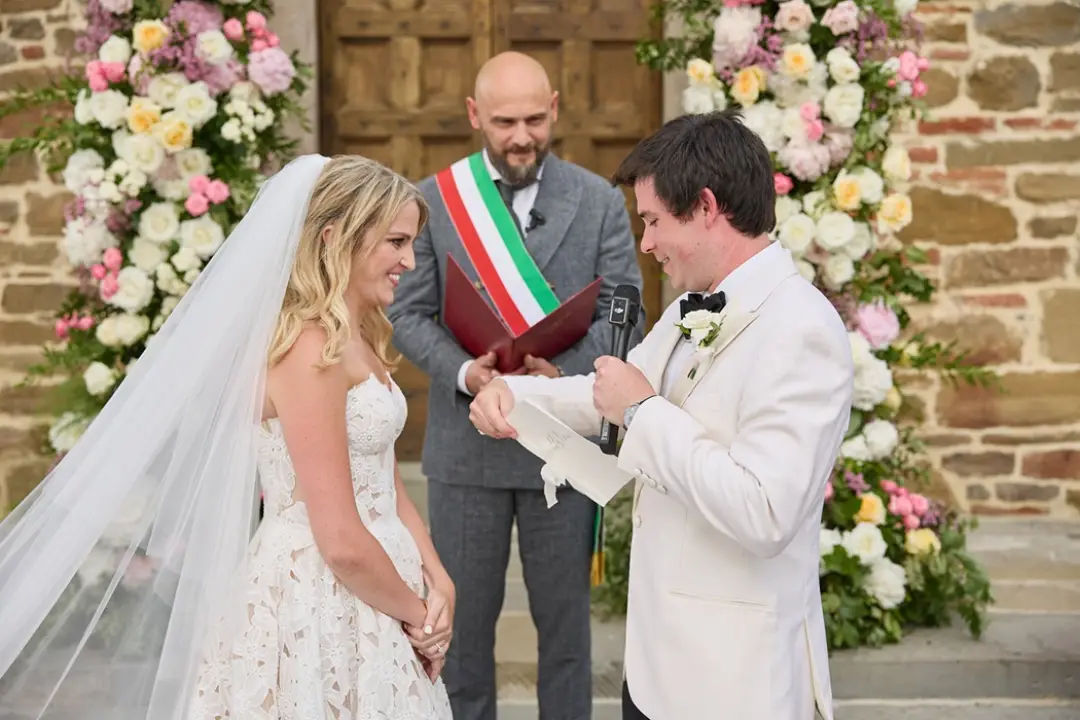
Planning a wedding abroad surely is an elegant and meaningful way to celebrate your union. And maybe your particular dream is to have a civil wedding in Italy, exchanging vows in a historic town, surrounded by art, architecture and centuries of tradition. It is an undeniably powerful idea – but keep in mind that, when it comes to the legal aspects, clarity and precision are essential.
If you are considering this kind of marriage in Italy, this guide will help you understand how it works, what the requirements for foreigners are, and how to approach the process with confidence.
What is a civil wedding in Italy?
Let’s start from the basics: a civil ceremony in Italy is a legally binding marriage officiated by the Mayor (or a delegated officer) of an Italian municipality. Unlike religious ceremonies, the civil rite is recognized by the Italian State and can be legally valid in your home country too, provided the proper documentation – which we’ll see in a bit – is completed.
Civil unions and weddings traditionally take place inside the Town Hall (Comune in Italian), often in historic and beautifully decorated municipal halls. Many Italian town halls are located in palaces, medieval buildings or Renaissance residences, making them far more refined than what you might imagine.
However, this is not the only option.
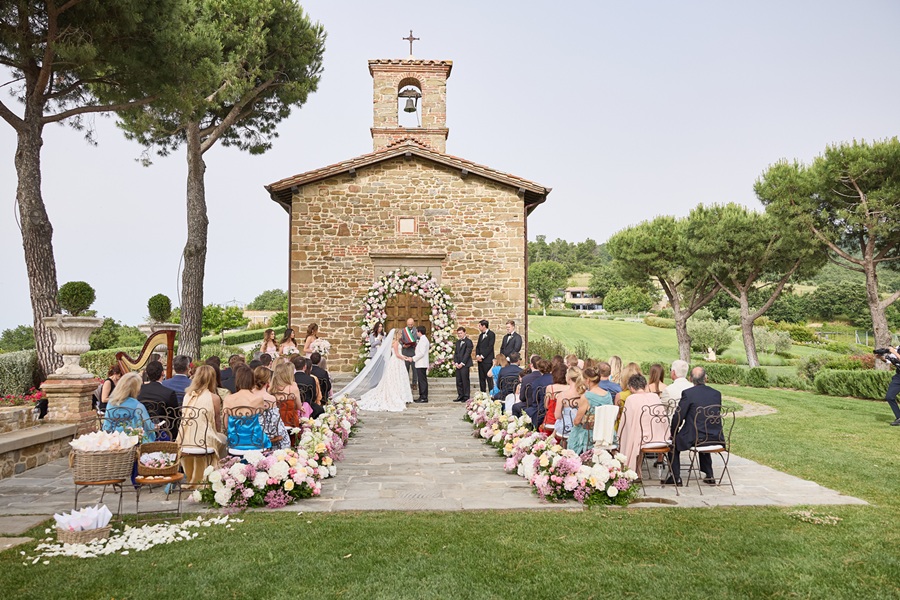
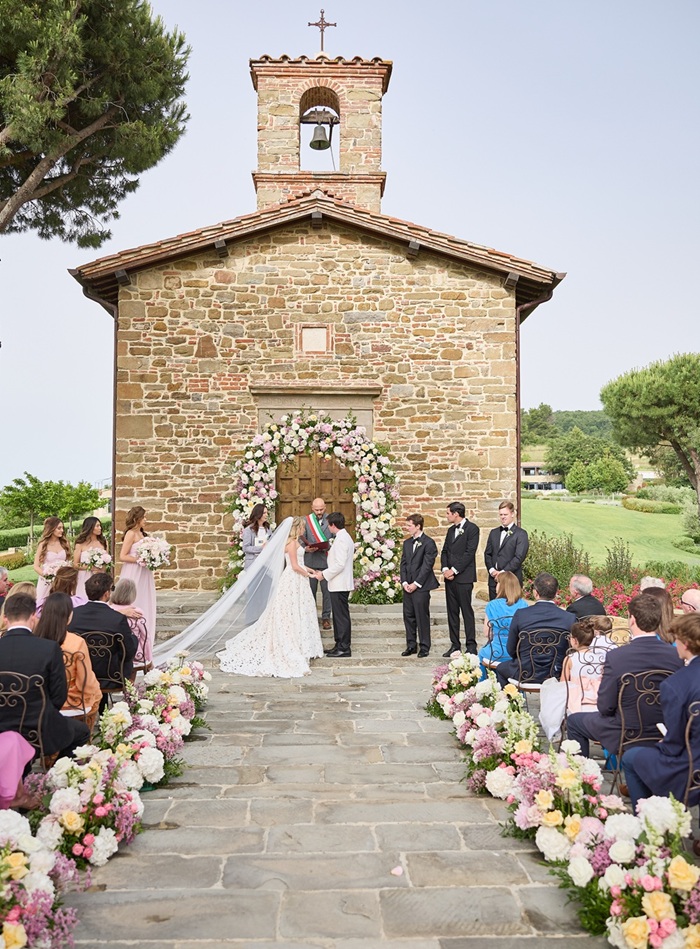
In recent years, several private venues have been officially designated as “Casa Comunale”, meaning they are authorized by the municipality to host legally binding civil weddings. This allows you to hold both the ceremony and reception in the same location, without moving guests from one place to another. In many cases, these authorized venues are more visually appealing than traditional town hall rooms, often outdoors, and, in our opinion, far more practical for destination weddings. If you want to get an idea, here is a stunning example of an al-fresco civil wedding we organized in Umbria.
Symbolic ceremony vs legal civil wedding
At this point, it is important to clarify one key distinction.
Many foreign couples like you choose to marry legally in their home country and then hold a symbolic ceremony in Italy at their wedding venue. A symbolic celebration offers complete flexibility in wording, location and format, without any related bureaucratic procedures.
However, if your wish is to celebrate the legal rite directly in Italy, as we said it is absolutely possible. It will surely include specific wording too – the celebrant will read the articles of the Italian civil code – but it can still be personalized with music, vows and readings. Moreover, of course, you need to meet the requirements for an Italian civil wedding and prepare the necessary documents in advance.
This is where the support of an experienced wedding planner, like Paolo Cicognani Exclusive Events, becomes crucial.
Civil wedding in Italy: the requirements and procedure
The procedure for a civil wedding in Italy (and civil union too) is consistent nationwide, although small variations may occur depending on your nationality.
Documentation aside, you will need two witnesses (one for the bride and one for the groom), who must be of age, to sign the legal documents together with you. Furthermore, if none of you speaks Italian, an official interpreter is also required, since the civil rite will be performed in Italian.
As far as the paperwork is concerned, in general, foreign couples must provide:
- Valid passports or EU identity cards
- Birth certificates
- Nulla Osta or Certificate of No Impediment (CNI), or equivalent document confirming you are free to marry, issued by the Consular Authority in Italy or in the home country
- Divorce or death certificates (in case of previous marriages)
- Official translations of all the documents and legalization or Apostilles, where required
For some non-EU citizens, such as American and Australian couples, a specific document called the “Atto Notorio” is also needed, together with the Affidavit “Dichiarazione Giurata” (Sworn Statement).
The Atto Notorio
The Atto Notorio is a sworn declaration stating that there are no legal obstacles preventing the marriage under your national law.
For Australian and U.S. citizens, this typically involves appearing before the closest Italian Consulate in their country of origin with two witnesses. This document has a validity of 90 days, which means that the wedding must happen within 90 days of its issuance.
In addition to this, you will also have to provide a document called Affidavit “Dichiarazione Giurata”, which replaces the Nulla Osta and is released by a Consulate or Embassy in Italy.

Timeline and procedure step by step
If you are foreigners planning a civil marriage in Italy, you should start preparing well in advance to make sure that things go smoothly. Here are the main steps to follow.
- Choose the Municipality where you want to get married and the specific venue for the ceremony, and inquire to request your preferred date.
- Once the date is approved, start collecting all the necessary documentation at least 6 months in advance.
- If you are U.S. or Australian citizens, schedule an appointment with your Italian Consulate to issue the Atto Notorio – make sure that this happens less than 90 days before your wedding day.
- After you obtain it, schedule an appointment with the Consulate or Embassy in Italy to issue the Affidavit “Dichiarazione Giurata”.
- Have all your documents translated into Italian and legally certified.
- Submit them to the Marriage Office of the Municipality where your wedding is taking place.
- They will give you an appointment, three or four days before the ceremony, to finalize the paperwork. You will need two witnesses and an interpreter in case none of you speaks Italian.
- At this point, you’re all set for your civil wedding in Italy.
Please note that each case varies slightly depending on nationality, so early planning is fundamental.
Although the process may seem complex at first glance, when handled correctly and within the proper timeline it is entirely manageable. What often creates confusion is misinformation from unofficial sources or incomplete explanations found online. This is why planning on your own would be a mistake – whereas relying on the guidance of professional wedding planners specialized in destination weddings – like us – ensures accuracy and avoids last-minute complications.
Is a civil wedding in Italy right for you?
Choosing to get married with a civil ceremony in Italy is a meaningful decision. It transforms your wedding into not just a celebration, but a legally recognized milestone in one of the world’s most culturally rich countries.
For some couples, the symbolic route offers greater simplicity and flexibility. For others, the idea of being legally married in Italy adds depth and authenticity to the experience.
There is no right or wrong choice: you should choose whatever better aligns with your vision.
One thing is sure, though: when planning a wedding in Italy, especially a civil one, the role of the wedding planner is essential. It is not limited to design and logistics, in fact, but it includes coordinating directly with the municipality, verifying documentation, scheduling appointments, and ensuring compliance with Italian law.
At Paolo Cicognani Exclusive Events, we assist couples step by step, whether they choose a symbolic ceremony or a legally binding civil wedding.
Because your wedding should feel inspiring and seamless. And when the legal foundation is handled with precision, you are free to focus on what truly matters: celebrating your love in Italy with confidence and emotion.
If you want us to plan your entire “Italian wedding” dream, get in touch with us.
Otherwise, feel free to fill the following form if you want us to assist you with the bureaucracy for your civil wedding.